Legionella Compliance in Hospitals and Healthcare: What Estates Teams Need to Know
.webp)
In June 2024, a patient at a UK hospital contracted Legionnaires' disease. It was not an isolated incident. Data from the UK Health Security Agency shows that 4.5% of legionellosis cases in 2024 were linked to healthcare facilities. Each one represents a preventable infection in a patient who was already vulnerable. For NHS estates and facilities teams, water safety is not an administrative exercise. It is a direct component of patient safety.
This guide is for healthcare estates managers, Responsible Persons (Water), and Water Safety Group members who need a clear, practical understanding of what legionella compliance requires in a healthcare setting, how it differs from commercial premises, and where digital platforms are changing what good oversight looks like.
.webp)
Why Legionella compliance in healthcare is different
Every duty holder managing a building with a water system has legionella obligations. In healthcare, those obligations are more stringent, the consequences of failure are more severe, and the systems you are managing are significantly more complex.
Three factors make healthcare premises uniquely high-risk:
- Patient vulnerability. Immunocompromised patients, the elderly, and those recovering from surgery are significantly more susceptible to Legionnaires' disease. Where Legionnaires' disease carries a mortality rate of roughly 10% in the general population, outcomes in augmented care settings can be considerably worse.
- System complexity. A large hospital campus may have hundreds or thousands of water outlets across buildings of varying ages, with pipework layouts that create dead legs, variable usage patterns, and multiple points of risk that require individual monitoring.
- Regulatory intensity. Healthcare premises are subject to HTM 04-01, a Department of Health technical memorandum that sets more stringent standards than the baseline L8 ACoP, and they face scrutiny from both HSE and the Care Quality Commission.
The regulatory Legionella complianceframework: L8, HSG274, and HTM 04-01
Healthcare estates teams operate under a layered regulatory framework. Understanding how the layers relate to each other prevents gaps.
L8 Approved Code of Practice (ACoP) is the baseline for all premises in the UK. It establishes the legal duty to identify and assess legionella risk, implement control measures, keep records, and appoint a competent responsible person. Compliance with L8 ACoP provides a strong legal defence if something goes wrong.
HSG274 provides detailed technical guidance supplementing L8, covering hot and cold water systems, cooling towers, and other systems in three parts. Part 2, covering hot and cold water systems, is the most directly relevant to day-to-day healthcare water management.
HTM 04-01 is the healthcare-specific standard. Published by the Department of Health, it applies to NHS Trusts, private hospitals, care homes, GP surgeries, dental practices, and any premises providing healthcare. It goes beyond L8 in several important ways:
- It requires the establishment of a formal Water Safety Group (WSG) and a written Water Safety Plan (WSP).
- It addresses waterborne pathogens beyond legionella, including Pseudomonas aeruginosa and other opportunistic organisms, which are a particular risk in augmented care settings.
- It sets stricter temperature thresholds in some clinical areas (55°C at sentinel points rather than 50°C).
- It mandates more frequent monitoring in high-risk areas such as augmented care units, endoscopy suites, and renal dialysis units.
- It covers thermostatic mixing valves (TMVs) in detail, given that they present both a scalding risk and a legionella risk if not properly maintained.
For private hospitals and independent healthcare providers, HTM 04-01 is guidance rather than a statutory requirement, but it represents the standard of care that both HSE and the CQC will apply when assessing whether your water safety management is adequate.
.webp)
The Water Safety Group: who needs to be in it and what they are responsible for
HTM 04-01 requires healthcare providers to establish a Water Safety Group. This is not a paper exercise. The WSG is the governance structure through which a healthcare organisation develops, implements, and keeps its Water Safety Plan current.
The Water Safety Plan developed by the WSG must document the water system inventory, the risk assessment, the control measures and their frequencies, responsibilities, and records of monitoring and remedial actions. In practice, this document is what an HSE inspector or CQC reviewer will ask for first.
High-risk areas in healthcare water systems
Not all parts of a healthcare water system carry equal risk. The following areas require heightened attention and, in most cases, more frequent monitoring than standard commercial premises.
Augmented care units including intensive care, haematology, oncology, and transplant wards present the highest patient risk. HTM 04-01 requires specific controls for these areas, including point-of-use filters in some circumstances and regular Pseudomonas sampling in addition to legionella monitoring.
Thermostatic mixing valves (TMVs) are installed to prevent scalding but operate at temperatures in the legionella growth range (they blend hot and cold water to deliver a safe outlet temperature of around 41-43°C). TMVs require quarterly inspection, annual servicing, and fail-safe testing. Failed or poorly maintained TMVs are a significant source of legionella risk in healthcare premises.
Shower heads and flexible hoses in clinical areas accumulate biofilm and scale that provide ideal conditions for legionella growth. They require quarterly cleaning and descaling as a minimum.
Infrequently used outlets across a large hospital estate include taps in rarely-occupied rooms, en-suite facilities in low-occupancy wards, and outlets in plant rooms. Weekly flushing of these outlets is required under L8, and in healthcare settings, compliance with flushing schedules needs to be demonstrable, not assumed.
Calorifiers and cold water storage tanks serving clinical areas require the same monitoring frequencies as commercial premises but with the added complexity that interruption of service for maintenance requires clinical coordination.
.webp)
The Legionella compliance tasks estates teams must do and how often
The table below covers the core monitoring and maintenance tasks required in healthcare water systems, the applicable frequency, and the guidance source. This is not a substitute for a site-specific risk assessment, but it gives estates teams a baseline reference.
The scale problem: managing hundreds of assets across a complex estate
A district general hospital with 500 beds might have 2,000 or more individual water outlets that require regular monitoring. Add legacy buildings with varying pipework configurations, a mix of clinical and non-clinical areas, and a workforce of estates engineers and contracted water hygiene companies, and the scale of the coordination problem becomes clear.
This is where paper-based systems fail healthcare estates teams most visibly. A flushing register for a single ward might run to dozens of entries per month. Multiply that across an estate of 20 buildings with varying risk profiles, and the administrative burden of maintaining, collating, and checking records manually is enormous. More critically, it is error-prone. Missed entries, inconsistent recording, and records that cannot be easily located at inspection are the most common compliance failures that HSE and CQC encounters.
The consequences in healthcare are not administrative. A missed flushing schedule in a ward serving immunocompromised patients is a patient safety risk. An audit failure that leads to enforcement action can affect an organisation's CQC rating and the trust that patients and commissioners place in it.
.webp)
How digital Legionella compliance platforms help healthcare estates teams stay audit-ready
The shift to digital water safety management in healthcare has accelerated in recent years, driven by the same pressures: scale, complexity, and the impossibility of maintaining demonstrable compliance through paper records alone.
What a good digital platform does that manual systems cannot:
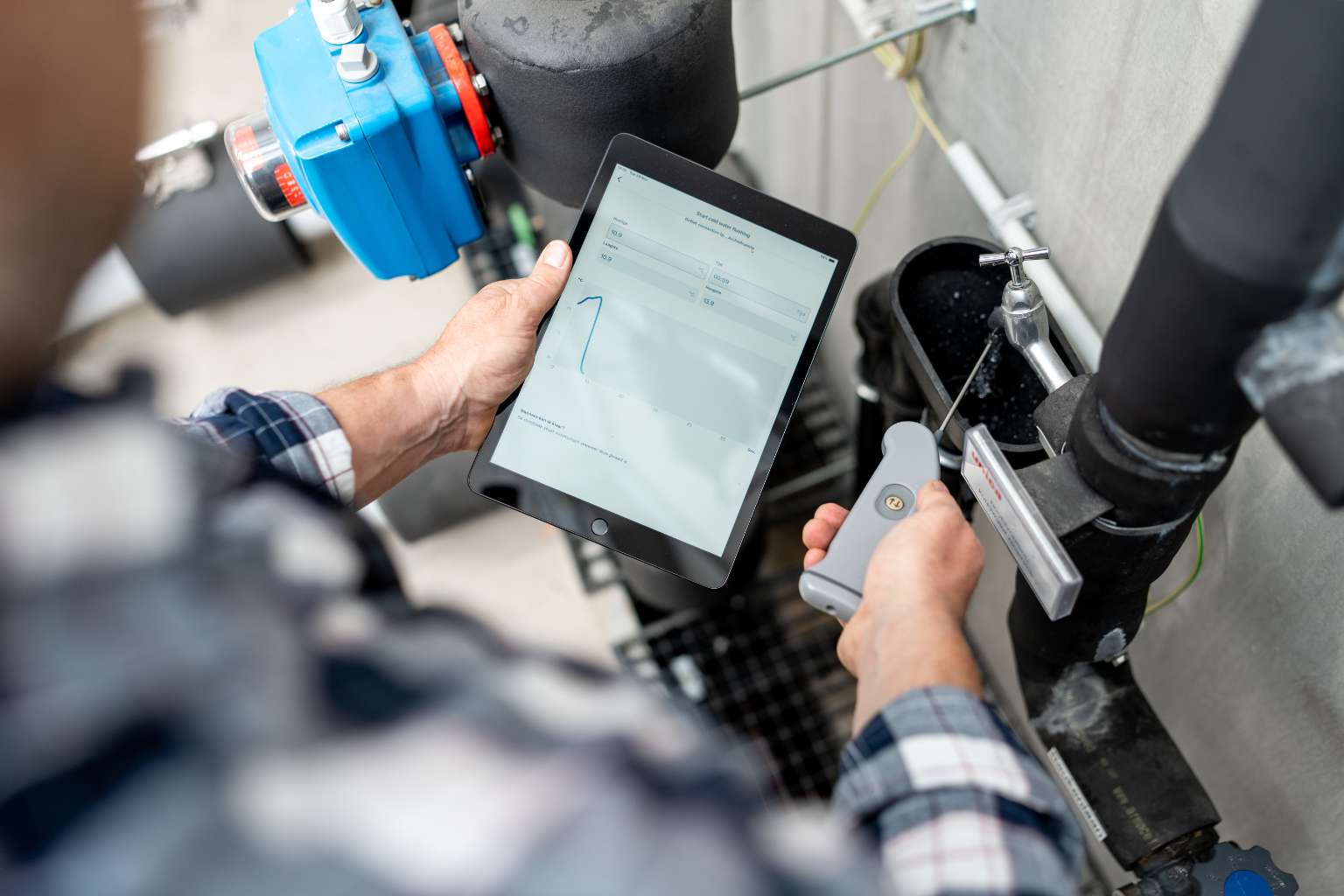
- Automates the compliance schedule. Every task in the Water Safety Plan is scheduled in the system, assigned to the responsible person or contractor, and triggers automatic reminders before and after the due date. Missed tasks are flagged immediately, not discovered at the next audit.
- Creates a tamper-proof audit trail. Every temperature reading, flushing log, TMV check, and remedial action is timestamped and attributed to the user who recorded it. This is the record an HSE inspector or CQC reviewer asks for, and it can be produced in minutes rather than days.
- Escalates non-compliance in real time. When a temperature reading falls outside the acceptable range, the Responsible Person (Water) is notified immediately. The remedial action is logged alongside the original non-compliance, creating the full evidence chain.
- Manages the full estate from a single dashboard. A Responsible Person managing multiple hospital sites can see the compliance status of every building at a glance, with outstanding tasks, overdue items, and recent non-compliances surfaced without manual consolidation.
- Supports the Water Safety Group. Risk assessments, Water Safety Plans, sampling results, and maintenance certificates all live in one place, accessible to every WSG member with appropriate permissions.
LegionellaDossier is used by NHS Trusts and healthcare estates teams to manage the full legionella and water safety compliance cycle aligned with HTM 04-01 and L8 ACoP. UKAEA, which manages a complex multi-building estate with significant water safety obligations, uses the platform to maintain continuous compliance oversight and produce audit-ready records on demand.
If you want to understand how this applies to your specific estate, book a demo and we will walk through your setup.
CQC and HSE inspections: what they check for
Both the CQC and the HSE have the authority to inspect healthcare premises for water safety compliance. Understanding what they look for is the most direct way to assess whether your current system would withstand scrutiny.
The CQC, in its Key Lines of Enquiry under the Safe domain, specifically looks for evidence that environmental risks are identified, assessed, and managed. For water safety, this means:
- A current, site-specific legionella risk assessment.
- A written and up-to-date Water Safety Plan.
- Evidence that the WSG meets regularly and that minutes are recorded.
- Complete and current monitoring records across all required tasks and frequencies.
- Evidence that non-compliances are logged, investigated, and acted on.
- Records of water sampling results and actions taken in response to positive results.
The HSE, when investigating a suspected Legionnaires' disease case or conducting a proactive inspection, will request the same documentary evidence and will also examine the physical water system for conditions that indicate the control programme is not being followed in practice.
The consistent finding in enforcement actions is not that organisations had no compliance programme. It is that they could not produce evidence that the programme was being followed. Digital records, timestamped and attributed to named individuals, are the most defensible form of that evidence.
Frequently asked questions
Do hospitals need a separate legionella risk assessment?
Yes. A legionella risk assessment in a healthcare setting must be site-specific and must address the additional requirements of HTM 04-01 as well as L8 ACoP. A generic commercial risk assessment template is not sufficient. The assessment should be carried out by a competent person with specific healthcare water safety experience and reviewed whenever significant changes are made to the water system or the building's use.
What is HTM 04-01 and does it apply to private hospitals?
HTM 04-01 is the Department of Health's technical memorandum on safe water in healthcare premises. It sets the standards for water system design, operation, and management in all healthcare settings. For NHS Trusts it carries near-regulatory weight. For private hospitals, independent healthcare providers, care homes, and GP practices, it is guidance rather than a statutory requirement, but HSE and CQC will apply its standards when assessing whether water safety management is adequate. In practice, all healthcare providers should treat it as the required standard.
Who is responsible for legionella compliance in an NHS Trust?
Ultimate accountability rests with the duty holder, which is typically the Trust Board or Chief Executive. Day-to-day responsibility sits with the Responsible Person (Water), usually the Head of Estates or Director of Facilities. The Responsible Person must be competent, trained, and supported by a Water Safety Group that includes clinical, facilities, and external specialist input. The Authorised Person (Water) holds the technical authority for higher-risk work on water systems.
How often do healthcare water systems need to be tested for legionella?
Sampling frequency is determined by the risk assessment and Water Safety Plan. As a minimum, sentinel points in high-risk areas should be sampled regularly, with the frequency increased in augmented care settings. After any positive result, resampling frequency increases significantly. In practice, most NHS Trusts carry out quarterly sampling as a baseline, with more frequent sampling in augmented care units and following any changes to the water system.
What do CQC inspectors check for in relation to water safety?
CQC inspectors look for evidence that environmental risks, including waterborne infection risk, are systematically identified and managed. In practice this means: a current risk assessment, a written Water Safety Plan, records of WSG meetings, complete monitoring logs covering all required tasks and frequencies, and documentation showing that non-compliances were identified, escalated, and resolved. Gaps in records, outdated risk assessments, and evidence of missed monitoring tasks are the most common findings that lead to compliance concerns under the Safe domain.
.webp)